Showing posts with label Museum. Show all posts

Friday, March 11, 2011

Art Science Museum @ Marina Bay Sands

The Marina Bay district of Singapore (heart of the downtown) has had construction ongoing since we arrived last year.  Several projects have completed, with several more still in progress.  The overall  area development is the flagship project of Singapore, and when completed will rival or exceed the spectacular views of The Bund in Shanghai.
The Marina Bay Sands integrated resort/casino opened last year, and in February, the Art & Science Museum attached to this complex opened.  This past weekend we went to check it out.  It, like many museums, is not a cheap date--  S$30.00 for adults for entry.  (I compare this with the US$26.00 and US$14.00 parking it cost to enter the newly rebuilt California Academy of Sciences Museum in San Francisco that we recently visited--  also a spendy day out).

Art Science Museum--  Marina Bay Sands, Singapore
The building housing the museum is unique--  it is shaped like a lotus flower, and sits on the edge of the bay.  The building has four floors--  the top floor gallery is dedicated to art and design--  with a large display on the design concepts that went into the museum building.
During our visit we toured three exhibits (not including the fourth floor art/design exhibit).
Shipwrecked:  Tang Treasures and Monsoon Winds
This exhibit was fabulous, featuring many artifacts, primarily pottery, recovered from a ninth century ship that sank near the Indonesian island of Gelitung.  The ship was Arab, and its discovery in 1998 was the first proof that Arab sea traders ventured as far as East Asia as early as the Tang Dynasty.  The pottery came mostly from central China (Xi'an), where a city of 1 million people mass produced goods, including pottery, for trade.  Thousands of pieces of pottery, and some gold and silver items were found in the wreck.
Traveling The Silk Road:  Ancient Pathway to the Modern World
This exhibit had few, if any artifacts, but presented a history of the Silk Road-- the trade route(s) between central China and Baghdad in the Middle East.  Four cities were highlighted along the route (Xi'an, Turfan, Samarkand, and Baghdad) and their role in servicing the traders and caravans of the route.  Although trade occurred for many items, silk was a major trade item, and often was used as currency for other goods and services along the route.  A part of the exhibition detailed the history of silk and how it is made--  fascinating.  (Silk worms are as domesticated as cows are--  they are blind, eat only mulberry leaves, and would now perish if left to fend for themselves in the wild.  Silk cocoons are literally unravelled to harvest the silk threads.  The coccoon must be boiled in water prior to unraveling, which is fatal to the pupae).

Silk Cocoons--  Each of these cocoons contains a silk pupae.  The cocoons are dropped in boiling water to break down the sticky binding agent.  The end of the threads are located, then "unwound" from the cocoon onto a reel, then processed for thread.
Genghis Khan
This exhibit highlighted the life and history of the famous 13th century Mongolian invader, and the empire he and his descendents created by conquering neighboring territories.  The Mongol empire stretched from Baghdad in the Middle East to the shores of the Pacific (although the Mongols were unsuccessful in conquering Japan), and from the edges of the Russian empire down to India.  The exhibit included many weapons and other artfifacts of the Mongol era, and described how Genghis was both ruthless and wise in his governance and organization.

Despite the expense I would recommend a visit to the museum, should you find yourself in Singapore for a visit.

Tuesday, April 20, 2010

Jewelled Arts of India

[Sunday April 11]--  On Sunday last Elaine and I visited the Asian Civilisations Museum (ACM) of Singapore.  A special exhibit was on display of jeweled artwork from the Mughal period of India (1526 to 1857).  The Islamic Mughal Empire first ruled northern India, and in its middle period, expanded to include southern India, although this region was rarely a stable member of the empire.  The British effectively put an end to the empire when they imprisoned the ruling Shah in 1857 after a series of uprisings threatened the stability of their trade.
As we learned from the exhibit, the Mughars were strong patrons of the arts (except for the third emperor, Shah Jahan, who was largely responsible for the decline of the empire).  This period brought a strong Persian influence on literary, architectural, and artisan culture to India.  The exhibit included amazing jeweled artifacts and jewelry, using mounting and gold work unique to this region.
A large number of the exhibit artifacts were daggers or swords--  perhaps a good indication of the state of affairs and life in the Mughar Empire at this time.

Asian Civilisations Museum, Singapore

Jeweled daggar from the Mughar period, Damascus steel

Jewelled sword hilts and sceptar

A gold embellished cup.  Although this vessel appears to be glass, it is actually carved from a solid piece of quartz.

Siimilarly, the grip from a sword, carved from quartz.

Jewelled bowls and containers.  Again, made from carved quartz.

A large carved emerald, inlaid with gold and embedded topaz.  Emeralds are not found in India--  this was likely from South America, brought to Indian artisans by trade with the Portugese.


A bowl, carved from jade

A jeweled carp

Sunday, April 18, 2010

California

[ March/April 2010-- ]  In late March Elaine and I traveled to the United States.  Elaine attended a week of business meetings in Boise, Idaho while I traveled to the San Francisco Bay Area to visit family.  Our second week was spent in Huntington Beach, California attending a memorial service for Ron, Elaine's step-father.

San Francisco
Well, full disclosure--  I visited my sister and her family, who live in Benicia, not San Francisco.  It was a good visit, as we last got together this past summer.  While here I was able to attend to a number of errands, such as visiting a dentist (bad news-- fillings needed to be replaced), and refilling pharmaceutical prescriptions.  Dental and medical services are very modern and available in Singapore, however this was a matter of convenience (the prescription-- some specific medications are not (yet) available in Singapore) and comfort zone (a U.S. dentist speaking English, not Singlish).  A couple of good meals out at Bay Area restaurants, not to mention at my sister's home, too.
The green flowered fields of Sonoma County, north of San Francisco.  This is a wonderful time of year for California.  In later months the spring winds will change the fields from their winter green to the summer gold.

While I was there we made a visit to the newly rebuilt California Academy of Sciences building, housing the Steinhart Aquarium and Morrison Planetarium in San Francisco's Golden Gate Park.  It was spectacular, albeit an expensive ticket ($25 for adults) for the experience.  I have great memories from my childhood visiting the two centers, but they had both become a little shabby and outdated, with their age.  (Something we all experience, unfortunately).  It is satisfying to see that San Francisco has recognized the importance of this center, and has made an investment into restoring it to new glory.

The DeYoung museum, viewed from the entry of the California Academy of Science. The DeYoung was rebuilt several years ago, and now the CAS has also been renovated.

The building is unique--  it has a "green" roof (see below), and is proported to be of an environmentally friendly design.  The aquarium has new tanks that no longer leak, as the older ones did.  There is an excellent Northern California coast tank, complete with wave action that is really stunning.   It is amazing to see what colorful fish and ocean life live just offshore.  The tropics don't have exclusive claim to beautiful fish.

The green roof at the new California Academy of Science building in Golden Gate Park.


Gary and Lois at the C.A.S. "green roof"

The new California Academy of Science building encorporates photovoltaic cell panels into its architecture and design, augmenting the power source  for the building.
A new exhibit is a four storey tropical forest, complete with living tropical plants and animals.  butterflies fly aloft the indoor tree canopy, and there are many live examples of the forest inhabitants (in containment) on display.  The theme of the exhibit is the crisis of the world-wide loss of this habitat and its place in our ecosphere.

Lois and Gary in at the tropical forest exhibit

The 1950's era planetarium theater has been replaced by a modern technology, digital projection system, with an impressive presentation.  A few things have been postulated and learned about the cosmos since the 1950's, and this has been refreshed in the new show.  I do miss the San Francisco skyline that was a part of the old planetarium theater (removed in the renovation), but that too was well out of date-- San Francisco has a considerable number of new buildings.

One welcome new addition is an underground parking garage, apparently built with some controversy.  Parking has been an issue in this area of the park for decades, with finally some solution.

Huntington Beach
One of the bright spots in the sad event of a memorial service is the gathering of friends and family, who would likely never be able to gather under other circumstances.  Ron's service was attended by friends and family who traveled from locations all over the U.S. (and world, including us) to show their respect for his lifetime.  Ron would have been pleased--  he enjoyed his visits and the connections to family, and had many stories about his times with them.
In attendance were relatives, traveling from Maryland, Idaho, Oregon, New Hampshire, Florida, New Mexico, and Indiana, as well as those living in the greater Los Angeles / Southern California area.  It was quite the gathering, and a large house that we rented provided a place to stay for many of the from-far travelers, as well as the post-memorial reception.  Elaine's son, aunts, uncles, cousins, nieces, nephews, and siblings were on hand for a family gathering that has not occurred for a very long time.
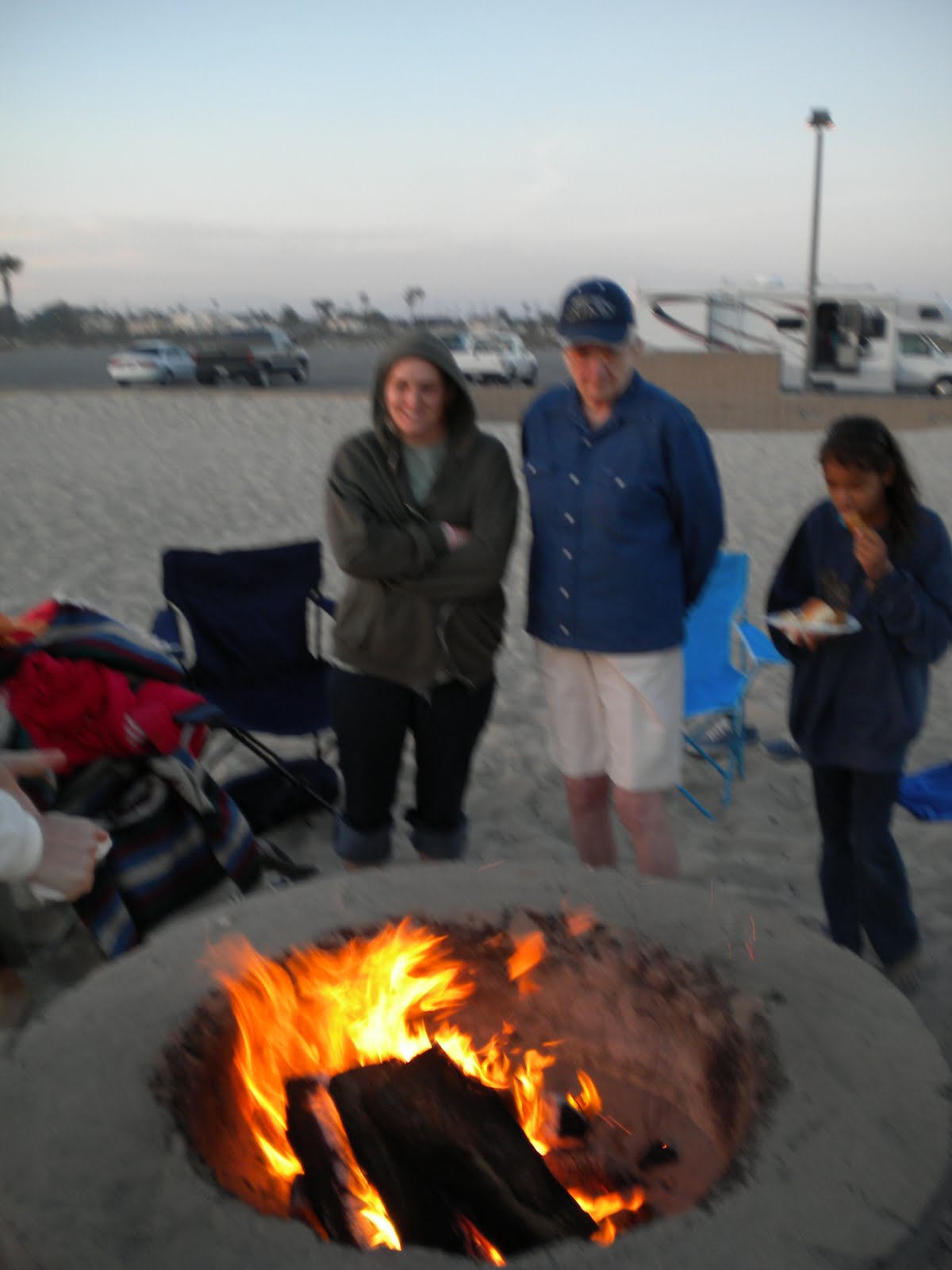
The weather was favorable, and allowed a beach picnic, complete with bon fire.  (Not just a good idea--  the weather was favorable but not  completely warm in the evening-- it is still winter/spring).

Jim, Elaine, and Aunt Mary in Pasadena

A warming fire at Huntington Beach

Sunset on Huntington Beach...

... followed  minutes later by (a blurry picture of) the full moon

Elaine's Aunt Dot (right) and cousin Nancy (left) from New Hampshire

Nathan (center) with Elaine's brothers John (left) and Robert (right)

Elaine with dessert, and Uncle Willard from Florida

Sunday, March 14, 2010

MOSAIC Music Festival 2010

[Saturday, 13 Mar-2010]  After a tough week at the office (for Elaine anyway), we decided to make the most of the weekend with several planned excursions for Saturday.  After carefully planning our route, timing, and modes of transportation we headed off down town for a fun filled evening of entertainment.

The World of Ancient Egypt
After our first visit to the National Museum of Singapore back in December, we enjoyed it so much we knew we would certainly return at some time during our tenure in Singapore.   This came to be true soon enough, as a touring exhibit opened in January that captured our attention-- The World of Ancient Egypt.  We went to the exhibit, and at that time purchased memberships-- at a break-even cost equivalent of two visits, and valid for two years.  What a deal!
The exhibit, a collection of Egyptian artifacts on tour from the Austrian Museum of History, although not a large collection, was quite well done.  We enjoyed the exhibit, although it was crowded, and sometimes difficult to view some of the smaller artifacts on display.
Some time after our visit, we received an e-mail inviting us, as museum members, to a limited private tour of the exhibit. Elaine signed us up, and we looked forward to our appointed tour date, this past Saturday evening.
Our tour turned out to be very private--  only three others and the tour guide made six, and were the only people in the entire exhibit hall.  The tour was presented by a volunteer docent from France named Benedict.  She was quite knowledgable of the exhibit and its artifacts, or appeared so, and able to answer most questions presented to her.  She told us that her preparation for the exhibit required over six months of research and study, and that this had opened new worlds for her-- her background was in finance, and not in Egyptology or history.   Her English was exceptionally good, with a beautiful French accent, giving the presentation a very international flavor.  Only a few of her pronunciations caused me pause in my comprehension--  I quickly adapted to her meaning in explanations of the Egyptian practices for the "diseased", when actually meaning the "deceased".
The tour was wonderful, and although our second viewing, it was like a completely new exhibit for us with the tour guide presentation.
After the tour we made our way (after briefly getting lost) to an Indian restaurant in downtown Singapore, for a wonderful dinner of various Indian dishes, including one 1-alarm, and one 4-alarm on the spice index.  I politely declined the 4-alarm (with only a small taste)--  as I am generally warm enough enduring Singapore's tropical climate.

Mosaic Music Festival 2010
After dinner, we walked over to The Esplanade, the theatre building adjacent to the Marina Bay, where the Mosaic Music Festival was under way.  This is a ten day event, similar to the Gene Harris Jazz Festival in Boise, or the Lyle Hampton Jazz Festival in Moscow, Idaho.  There are both free events, and pay events, and there are workshops for musicians, and musician students.  However Mosaic spans many genres of music styles.  A couple of the pay-event performers include Branford Marsalis Quartet and Kool and the Gang  (didn't know they are still touring).
We arrived just in time to catch the end of the last set of The Greg Lyons Quintet, a local contemporary jazz band.  We then wandered to the outdoor theatre (backed up to Marina Bay) where we greeted by the sounds a local Singapore band (Blue on Blue) playing a very nice cover of Hey Joe (Jimmy Hendrix).  This was followed by a Led Zepplin tune, and some other blues numbers.  Excellent!  After a short break, a jam session featuring the members of Blue on Blue, and a Thailand blues band called Skunk Jive.  Amazing!   We started to leave, but were lured back to listen the last toe-tapping number of the evening from the combined band blues jam.  We stayed so late that the MRT had closed for the night, and we had to take a taxi home.
We hope to visit again later this week to hear some reggae.

The blues band Blue on Blue plays on stage at the Esplanade Outdoor Theatre, with Marina Bay in the background, during day #2 of the Mosaic Music Festival.

Blues band Skunk Jive performing at the Mosaic Music Festival.  The band is from Thailand, and sound like they sing the blues from Chicago, IL.  The female band member, playing guitar here, is their featured vocalist, and may be able to hold her own against legendary blues singer Ruth Brown, or Janis Joplin.

Lights of downtown Singapore on Marina Bay provide a backdrop for the MOSAIC Music Festival at the Esplinade Outdoor Theatre.