Thursday, July 7, 2011

Return to Palau Ubin

[Updated 8 July, 2011-- Photos from Sec-Sea]
Palau Ubin--  Getting the kayaks ready to head out.  Rosita (watching from the surf) was our lead guide-- very pleasant, and a fun attitude.  Our total paddle was about 4 km.
Last weekend Elaine and I made our second trip to Palau Ubin.  (Palau is Malay for "island").  Palau Ubin is one of five small outer islands that are a part of Singapore.  It is mostly a reserve, but there is a small village of inhabitants.  It is accessible by "bum boat" ferries, which cost S$2.50 for the 10 minute ride across the strait.  The boats are a bit dodgy--  they are wooden, and look like they have been in service since the time of Sir Stamford Raffles.  However the captains are quite skilled, and I'm unaware of any mishaps, at least since our time here.  Palau Ubin is quite crowded on weekends, as it is a popular destination for a day trip to fish, mountain bike, or hike.  It is very rustic-- and touted as "what Singapore was like 25 years ago".  Tin roofed shacks rather than concrete high rises are the norm.

Our purpose for a second trip to Palau Ubin was to take part in a sea kayak tour.  Elaine has been wanting to do kayaking in Singapore for quite a while.  For some unknown reason, you must be "certified" to be able to hire a kayak and paddle about the reservoirs and/or coastal areas.  Certification means taking a course from the agencies that rent out the kayaks.  Since Elaine and I have been in both river and sea kayaks, it was not clear what we might gain from the certification.  However, the training course schedules just never worked out.  The kayak tour was guided through the mangrove area of Palau Ubin, and required no previous experience.  The kayaks were tandem, the sit on top type.

Full disclosure:   My interest in kayaking in Singapore has been significantly less than Elaine's.   Actually zero.  The reservoirs are limited, and thoughts of four plus hours in the tropical sun/humidity were not appealing to me-- I would have skipped the whole event.  However, Elaine persisted and the kayak tour was booked.  It turned out to be a good day.

We were fortunate--  there was a nice breeze blowing (unusual), and periodic cloud cover, which kept things relatively cool.  At one point during the tour it rained.  Since we were dressed to get wet, it was not unpleasant, and the rain lasted only a few minutes.

Although we have kayaked previously, I think this was our first time together in a tandem.  Marriage on trial.  Kayaking is similar to canoeing, but because of the double bladed kayak paddles and smaller boat, there is a greater requirement for synchronization (and communication).  Compared to others in the tour group I think we did very well, but not without some disagreements and confusion.  Elaine did not drown me and we both returned safely to the jetty--  no one left  behind stranded on a mangrove sand bar.

I would rate the tour as OK-- but too many people on it.  Perhaps one of the longer tours would be better. We saw (briefly) some Oriental pied-horned bills (like a toucan), and mudskippers--  a strange, nearly amphibious fish that skates along the surface of the mud and/or water.  We've seen small ones before, but  saw a couple that were 6 to 8 inches in length.   And lots of hermit crabs.  Apparently a Collared Kingfisher was spotted by the leader (these are highly colorful birds) but it was long gone before we reached the location-- the tour consisted of 30 persons, and in places in the mangrove, we needed to pass single file through a narrow channel.  A much smaller group would have been preferable.  There are wild pigs on the island, but none sighted on this excursion--  we saw some on our first visit to Palau Ubin.  The tour was hosted by Sec-Sea (Sea Expeditions Centre of South East Asia), a professional and fun tour outfitter.  This is the tour we did.
Training--  A little orientation and training before we head out.  Yes, I've always been the attentive student.  What did you say?

Instruction --on how to parry and block that blow from your exasperated kayak partner's paddle.
Trained, suited up, and ready to paddle
Heading out--  This picture captures a tragic reality of the waters around SE Asia-- the plastic and trash.  Singapore works hard to keep things clean, but with the dense population and the enormous ship traffic in the region it is an enormous task.  We were required to wear closed toe shoes as a precaution against glass, etc.  Fortunately this was only a particularly bad area--  most of Palau Ubin is much better.


I'm providing directions and encouragement, Elaine is doing the paddling (heh, heh, heh)
Don't try this at home--  What's that they say?  Never stand up in the boat...

Single file--  With a large number of kayaks and narrow passages, we go singe file into the mangrove lagoon.
Mangrove--  the mangrove trees are salt tolerant and provide an ecosystem habitat.  Algae grows on the roots, attracting small marine life, which of course attracts larger marine life.  The mangrove provides a habitat where the fish can hide.  The mangroves also act as a filter to trap nutrients.
Mudskipper--
Getting really narrow now .  The water also was very shallow in the lagoon. We nearly got trapped in a lagoon, as the tide went out, which would have required pulling or carrying the kayaks out on the mud.  I'm glad we avoided that-- the mud is super fine, and sticks to everything.
Oriental Pied-Horned bills--  Do you see the horn bills?  No, we barely did too.  The horn bills flew over and landed high in the trees.  However they give away their location by a cackle that can be heard for quite a distance.  (Probably just laughing at the amateur kayakers below).


Better picture--  Here's a picture of the Horned bills, courtesy Sec-Sea.

Hermit crabs--  We stopped at a sand bar near the entrance to the lagoon, where there were hundreds of snail shells, and a proportionate number of hermit crabs.  The crabs eat the snails, and take over their shells.  There is one (in a shell) at the top of the photo.  Not a terribly exciting picture, but the first underwater photo with the new water proof camera  (thanks Lois & Gary!).
Shell Squatters--  Lots of hermit crabs in the estuary  (Sec-Sea photo)


Mangrove lagoon--  This is the lagoon that rapidly lost its water due to the falling tide.  We paddled about in here for only a few minutes (maybe 5) before we realized we had better paddle out or face walking out.

Tuesday, June 28, 2011

Cirque Eloize

The Marina Bay Sands Resort complex, opened last year has two theaters, and has been bringing in some interesting shows.  We went to see Lion King, which was very good.  I never saw the Disney movie, but the play had some outstanding costumes and a remarkable set.
Last week we attended the Cirque Eloize, which was beyond amazing.  This is a show in the manner of Cirque de Soleil, with nonstop action.  It was a mixture of Broadway dance, street break dancing, X-Games, and gymnastics.  The troupe is a group out of Canada, that tours world wide.  (This was a formal  show, similar to the group we came across performing in a shopping mall for a Christmas promotion).

I was trying to imagine a bulletin for recruiting performers for this group.  I think it might go something like this:
WANTED:
 Broadly talented entertainers with superb athletic and artistic abilities to perform in a ballet-circus type performing group.  Applicants must meet the following requirements:
-  Strong abilities in modern dance
-  Skillful jugglers
-  Highly skilled in gymnastics, including tumbling, high wire, and ring.  Must demonstrate strength and skills in partner gymnastics.
-  Demonstrated skills in trampoline gymnastics
-  Demonstrated skills with bicycle gymnastics
-  Must be extremely flexible, multi-jointed.  Contortionist abilities a plus.
-  Great endurance-- must be able to perform the above skills and acts for the duration of a 2 or 3 hour show.
-  Strong teamwork--  must demonstrate an ability to work with others and trust their own skills in dangerous team performance acts, that potentially could result in your own injury and/or paralysis.
-  Olympic medal winner a plus

If you have the opportunity to catch one of these shows, don't miss it!

Monday, June 27, 2011

Please Sir, I Want Some More

One of the "delicacies" of SE Asia is Durian, a regional fruit.  (See my post last year).  As one local Singaporean put it, "Most Westerners don't care for it".  That is an understatement.  It is definitely an acquired taste, although we have one Western expat friend that likes it very much.  It has an extremely strong odor, so much so that it is not allowed to be carried on the MRT (subway train).  It is sold in the local grocery store where I do most marketing, when in season.  At first the smell was difficult to deal with, but I am now accustomed to it, and barely notice it.  Eating it, on the other hand, is a different manner.  I have tried it, but can't say I "care for it".
So it was with some amazement that I came across this recent news story about the Guiness World Record for eating durian.  Sixteen seeds (the fruit has large pods inside its husk, each about the size of a tangerine) in a minute.  Since it took me several seconds to even begin to brave consuming my small sample of one pod, (with help of a vodka chaser), I am humbled and awed by this feat.

Melaka (a.k.a. Malacca) Malaysia

One of the places we have been wanting to go see is Melaka (also spelled "Malacca") in Malaysia.  It is a relatively easy journey, and last weekend (June 18-20) we made it happen.
Melaka is a very old city, and is registered as a UNESCO World Heritage Site.  It is located on the Malacca Strait, which separates Indonesia from the Malaysia peninsula.  The location is strategic, as the Malacca Straits are the passage connecting  the Indian Ocean with the South China Sea, and eastern Asia.  It is precisely at the narrowest gap of the straits.  As a consequence of its location, it has been the battle grounds of imperialist nations for centuries, desiring to control the lucrative trade route.
The city was founded sometime around 1300 by the Malay sultans.  In the early 1400s the emperor of China sent his "ambassador" Chung Ho, along with an an entourage of 27,000 emissaries, and a fleet of thousands of ships on a world voyage mission to establish trade relationships with China.  He completed seven voyages, and stopped at Melaka on at least two of these voyages, hanging around until the monsoon winds were favorable to return to China.

In 1511 the Portuguese conquered Melaka, and established a fort at the location.  The Portuguese not only wanted to establish trade-- they wanted exclusive control of it.  Ships stopping in Melaka were required to pay a tax, and those that didn't were sunk or their cargoes confiscated.

Next came the Dutch, who took over Melaka from the Portuguese in 1641.  The Dutch handed over control of Melaka to the English in 1795 in fear of it falling into the hands of the French (Napoleon)-- a supposed temporary arrangement.   The port declined as a trade center, as its harbor became silted, and the emergence of Singapore and St. George as the more favored trading ports in the region.  (Singapore was founded as a free trade port).   At one point the British were planning to destroy the city and deter its reemergence as a competing trade center (to Singapore and St George), if returned to the Dutch.  The Japanese occupied Melaka and Malaya in 1942 until their surrender in 1945.  Malaya became an independent nation in 1956
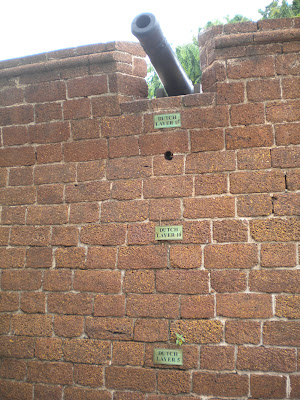
The old fort walls of Aforteleza, the fort originally built by the Portuguese in 1512.  The fort was altered, expanded, destroyed by following rulers-- the signs indicate the various wall additions and changes by the Dutch.
Elaine (right) and our friend Alesa, our travel companion for this trip, holding down the fort.  Elaine met Alesa at the bus stop in Singapore one day, and struck up a conversation.  She is a professor of Communications at a local business school here in Singapore.  As it turns out she attended school with my sister at UC Santa Cruz.  Is the world a small place, or what?
Stadthuys--  located on Dutch Square facing the Melaka River, and built in 1650.  This served as the official residence of the governor, and as an administrative centre.  Currently it is the Museum of History and Ethnography, one of several museums in the city.  (Melaka has more museums than any other city in Malaysia).  The red color is true to the period, and allegedly was originally painted with the juice of betel nuts, which are native to the region.
Christ Church--  a protestant church built by the Dutch.  Construction started in 1741 but wasn't completed until 1753.
For hundreds of years, people from many cultures including Arab, Indian, Chinese, and others came to Malaka and settled. Particularly under the English, many Chinese settled in the area. Peranakan (a cultural mixture, primarily Chinese and Malay) created a unique culture for the area.
As a consequence of the variety of cultural influences over the centuries, Melaka has an interesting blend of architectures in its old city.
St. Paul's Church (ruins)--  This church resides on the hill above the old city.  Built in 1521 by the Portuguese and named "Church of our Lady of the Hill".  The Dutch renamed it St. Paul Church, and used it as part of their fortress.  There are some impressively carved memorial stones inside.
Inside St Paul on the Hill (ruins)

We stayed at a backpacker guest house (200 years old) along the Melaka River--  not Michelin 5-star, but clean, and very friendly.  And inexpensive-- RM19 per night (about US$7).  The guest house was a typical structure for the area along the river-- a warehouse on the first floor, with access to the river in the back, and business conducted along the street from the front.  The merchant owners lived in quarters upstairs.  This is a typical shop house style structure evident here and in Singapore.
Melaka River, from our guest house.  The river has walkways along most of the old city area, on both sides.  Tour boats ply the river all day and most of the evening.
Pedal Power--  One of the opportunities for visitors to Melaka is a ride in one of the Tuk Tuks.  They are ornately decorated with large bugs (in this case a bee) or flowers.  Apparently a most modern addition for them are  high powered car stereo systems, electronic horns, or other paraphernalia which allows you to go deaf while being pedalled about the old town.  Apparently Malaysia (or maybe just Melaka) is caught in some type of music time warp--  nearly all of the music heard in the restaurants, shops,  and Tuk Tuks were Western songs from the 70's and 80's.
In the old town square there is a replica sailing ship, which is part of the maritime museum.  School girls on a field trip.  The front.....
... and the back


Melaka--  a distance of approximately 250 Km, that should take 2 1/2 hours, but actually took about 4 1/2 hours.  The delay is incurred by the heavy weekend traffic, and the need to go through immigration and customs control.  At the Singapore border everyone exits the coach, goes through immigration to have their passport stamped.  We then re board the coach and drive about 500 meters to the Malaysia control center to pass through their immigration and customs.  (You need to remove all luggage and belongings from the coach).  The process is repeated in reverse on the return journey.  The coach travel was very pleasant, and reasonable-- S$45 (US$36) round trip.

Melaka was quite warm and humid-- about 32C, which made walking about a little challenging, with frequent breaks for air conditioning and re hydration.  Air con is less prevalent in Malaysia than Singapore, with many of the museums and shops having only fans.
Dragon Boat--  while we were in Melaka a dragon boat race was being held on the river, at the Malaysian Heritage Centre.  The person in the front has a drum to establish cadence for the paddlers.  The person in back (standing) attends to a rudder to steer the boat.  Apparently everyone else drew the shorter straws.
Water Monitor--  These guys are a pretty common sight along the river.  This one is moderate sized.  Another that we saw may have been 4 or 5 feet in length!  They are rather shy, so not much of a threat.


These characters are rather common sights as well.  Many cats in Singapore and Malaysia have a curious genetic defect that results in tails that have an abrupt right angle bend to them.  These two were pleasant enough, but in my opinion a lot of the cats in the Singapore 'hood look like they have an attitude-- perhaps the over sized ears and small head.  It is illegal to have cats as house pets in the public HDB housing in Singapore-- there are volunteer "feeders"-- cat lovers that bring cats food.  Singapore is just now initiating a program that captures the wild cats, neuters them, and then returns them to their capture location.  I am not sure of the policies in Malaysia.


Architecture--  Because of the variety of invaders and inhabitants, Melaka has a fascinating mix of building architecture.  This is the Malaysia Independence Memorial Hall 

Sultan's Istana--  Each of the states of Malaysia were once ruled by sultans (chiefs).  The architectures of buildings in these various regions of Malaysia vary considerably.  This is a replica of the Istana (palace) of the sultan of Malacca, now a museum.  Inside are beautifully carved panels and doors, with hardwood everywhere.


Melaka has a strong Chinese heritage-- the immigrants created a unique Paranakan culture.  Pastel colors of pink and turquoise are common.


Temple Road has a representation of many faiths within a block, with Hindu, Muslim, and Buddhist temples.  This is the Buddhist temple, which is spectacularly ornate.


Scourge of the Seas--  We walked to the coast where the Melaka River enters the Melaka Strait (the Barrage).  As we have seen in most the coastal areas of Southeast Asia, Melaka was no exception.  There is a LOT of trash floating about in our oceans.  Plastic.  It has been a wonderful creation for man, but with a terrible dark side.  It is a pollutant that doesn't go away, and it is harming the habitat.  Please do your part to minimize its use, and dispose of it properly (for recycling).  This is a crisis that few people are aware of.
Homesick--  This was a small reminder of Boise, and our neighbor state to the south, Utah.

Art Gallery--  We weren't quite sure about this style of art. :-)   And surprising for a conservative Muslim country!


Sunday, June 12, 2011

Power Chairs

One of the more interesting companies that has sales outlets all about Singapore is Oto.  They are a local company specializing in "health and body care" products.  Aside from some products I consider a little dubious (embedded magnet health bracelets and sandals, etc.) there is a line of... power relaxation chairs.  This is no ordinary chair.  Should you be so fortunate as to have one in your house, you will need to protect your turf from the other household members who will covet your evening retreat.  In addition to the comfy back, side, and seat, it has leg rests that envelop your calves, all of which will massage away those stresses from the day.  This thing will be the center piece of your family room or den, and be front and center for notice by visitors.
But alas, comfort does not come cheaply.  A power relaxation chair such as the Cyber Pro 2900 (the high end model) retails for S$2680.
This puts  Archie Bunker's All In The Family chair to shame.

Hello Dali

One of the recent additions to Singapore has been the Art and Science Museum at the Marina Bay Sands complex.  It is a strange looking building, which resembles a lotus flower, with some of its petals fallen off.  It sits on Marina Bay, the central showcase area of downtown Singapore, along with Marina Bay Sands, a large resort and casino complex, with what looks like a ship perched 55 floors up.
Art Science Museum on the Marina Bay, Singapore
We have now been to three exhibits at the museum (see Art Science Museum), which has become a  part of our standard tour for in-town visitors (as well as the Sky Deck at MBS).  While Elaine's mom, Barbara was visiting this past May, we attended an exhibit of Salvador Dali art showing at the museum.  The exhibit featured mostly sculptures, some of which we had seen previously at an exhibit in London several years ago.
Dali's art has always impressed me--  it is very bizarre indeed, and I admit I fail to appreciate or recognize the symbolism embedded in it.  But I find it interesting to look at.  I particularly like his "clocks" themed work, and Dali Vision, a creative mosaic approach of pictures that are pixelated with miniature pictures within pictures.  Most famous is his "Abraham Lincoln" portrait, a print of which hung in our house for several years.  Unfortunately this exhibit did not include any Dali Vision pieces.

Dali had a thing with drawers, which is a recurring theme in several of his works.

This sculpture was outdoors at the museum entrance
Clocks are another recurring theme, and several pieces in the exhibit had clocks.
More works of art (but not by Dali)--   Barbara and Elaine on top of the MBS Sky Deck, overlooking Marina Bay, Singapore