Showing posts with label Shanghai. Show all posts

Sunday, June 13, 2010

Shanghai PRC: Expo 2010 Day #2

 [Monday May 31]--  We returned to the Expo on our final day in Shanghai, and visited as many pavilions as we could.  Our plan was to stay into the evening (which we did) and witness the fireworks that are done every evening (we didn't stay that long).  The expo was a great place to visit-- I wish we the queues had been shorter such that we could have seen more of the larger pavilions.  However, I found the experience to be worthy of our expense in traveling, and I hope to visit Shanghai again sometime.

The promenade walkway at the expo.  There were two promenades that intersected one another-- they're enormous.  The promenades are elevated steel decks-- there is also a walkway underneath.  (The major promenade also has an additional sunken level that connects to the subway.)  I have tried to imagine how much steel went into the construction of these promenade decks alone.  There were a few electric 6-seat vehicles (like a large golf cart) powered by fuel cells, that shuttled people along the promenades, if you were willing to wait for them.  No people up here--  they are all in the queues trying to get into the pavilions.

Perhaps one of the most interesting, and in my opinion most creative, was the Chile pavilion.  The entire inside was constructed of a sculptured plywood, featuring the natural resources of Chile.  They also were featuring Chilean wines, and had free wine tasting!  Apparently this was an exception-- we were there on the right day at the right time.  We spent some time talking with a couple of the Chilean representatives, who were very friendly and informative.  We were told that, although the earthquake was very destructive, the Chileans are very familiar with earthquakes and will pick themselves up, rebuild, and move on-- quite stoic.  They also said that wine production this year will be very minimal, as one of the primary wine regions of Chile was heavily impacted by the earthquake.  Chile is high on our list of future places to visit--  definitely a fly fishing destination.
Russia pavilion--  large queues to get in

 
Ukraine pavilion.  Their exhibit featured a small cafe style restaurant, where we had lunch.  What else-- chicken Kiev!

 
The United Kingdom pavilion as seen from the Netherlands pavilion.  The U.K. pavilion was "Thousand Points of Light", and built around a theme of a project launched by Kew Gardens in London.  The project plans to archive and catalog plant seeds from around the world, as many species become extinct from climate change.  Nope-- didn't get inside.  Major queues.

 
The Netherlands pavilion.  One of the more bizarre exhibits, this pavilion was a spiral ramp with a number of small exhibit windows that featured both the artistic, agricultural, and technological prowess of The Netherlands.  At first I thought the small window exhibits were art exhibits (one or two were), but then realized that each was a contribution of something from the Netherlands.  One window showed a large steel diamond covered cable--  a section of a cable used to slice apart and recover the soviet submarine Kursk from deep water.  Another exhibit appeared to be a gas pump.  In reality, it is a water purification system developed by a Dutch company that can be brought to disaster areas to dispense purified water.

 
Fill 'er up-- Not petrol, but water. This is the distribution end of a water purification system that can be brought into disaster areas to purify and pump water for victims in areas where the water supply has been fouled.

What would a Netherlands exhibit be without tulips? I thought they were artificial at first, but no, they are the real thing.


 A flock of plastic sheep, grazing on indoor/outdoor carpet-- a tribute to The Netherlands agriculture no doubt. These were present underneath the elevated pavilion, and popular with the Chinese kids to sit on (as intended).

For anyone planning to attend the Expo, my suggestion would be to go in the evenings.   Shanghai is a city of lights, and the Shanghai Expo has followed this lead.  The pavilions are spectacular at night.
Malaysia Pavilion


Norway Pavilion
  
Ukraine Pavilion

United Nations Pavilion

The Lupu Bridge--  the lights on this bridge, which crosses directly over the Expo site, change colors.  The bridges and buildings light shows in Shanghai are almost as good as a fireworks show.  This picture also shows the promenade walkway, which connects the various sections of the expo.

Chinese Gardens--  The Expo site included a Chinese Garden, which was a great place for people to relax and take a break from the queues and walking about the pavilions.  There were bird cages (See Shanghai:  The French Concession) and bonsai plants and art-rock.


Turtle Rock--  This rock, among others is natural (not carved) and has a striking resemblance to a turtle.  There were others-- one that looked like an elephant.

Saturday, June 12, 2010

Shanghai PRC: The Bund

[Sunday May 30 Evening]--  The architecture and sites of Shanghai is fascinating by day, but the city really comes alive at night.  One of its features are the lights that are on every major bridge and building in the city.  An area in the oldest part of the city is called The Bund.  This area was the center of commerce, and location of many of the wharfs along the river.  The area frequently flooded, and so a levee was built to protect the city.  The levee is called The Bund (literally translated, "the beach").  There are many old buildings in this area, as well as new.  The government has taken steps to protect and restore these heritage architectures.  On the far side of the river (Pudong district) there are many new buildings and tower.  As you can see, they are lit colorfully.  (One tall downtown building has search lights  at night--  I thought we might actually be in Gotham City!)
Chinese Dinner--  While in Shanghai we were hosted for a dinner by an HP acquaintance in Shanghai and HP friends from Singapore, who happened to be in Shanghai at the same time.  From left to right:  Sunny (HP employee in Shanghai), Karen (works with Elaine in Singapore), Matthew, Dr. "Zinny" Ho (Karen's husband), Elaine, and Jim.
Elaine, Jim on The Bund, Shanghai


The Bund Walkway--  Just a few folks out enjoying the incredible lights of Shanghai from The Bund.  This picture was taken about 23:00.

River Cruiser--  A river cruiser competes for attention among the lights along the Bund.

Dragon Boat--  This one grabbed my attention...

Large scale digital imagery

Discotheque--  This odd shaped building along the Bund has an outdoor disco on the top floor.

New--  The blueish lit building in the background is a recent addition to Shanghai.  It is one of the tallest buildings in the world.  There is an open area near its top, with a sky bridge connecting the two towers.  The sky bridge has a glass floor.  We didn't get to go in the building, but its construction was featured on The Discovery Channel.

Old--  circa 1920's on The Bund


When you are walking along the  Nanjing Road pedestrian mall (and nearly anywhere else in the Bund area) you can expect to be constantly approached by touts and hucksters--  people who are selling counterfeit merchandise.  This is particularly true if you are obviously a Westerner.  (Some friends from Singapore had no experiences with touts).   Some of the touts are only trying to sell laser pointers or strap-on roller skates that light up.  However most have small laminated brochures with dozens of pictures of the many wares they are peddling.  "Shop-ping!  You want bags, watch, i-Phone, T-shirt?"  Some can be quite persistent, following you along the walkway for quite a distance.  We declined to participate in this black market--  not sure what kind of "deals" you might get.  In general (legitimate) prices are very inexpensive in Shanghai, which was a very pleasant relief from Singapore, which is very expensive.  There are police officers everywhere, but there appears to be tolerance to the touts.
But not entirely.  On our return to our hotel from The Bund, we witnessed a tout selling counterfeit Expo 2010 merchandise being rousted by the police.  (Looked like Haibo key chains)  A police officer chased after him and confiscated his goods.  Seeing this, a number of other touts starting running away, with their bogus Expo 2010 wares.  There are apparently certain limits to tolerating counterfeiting goods, that when crossed, bring about law enforcement.
Counterfeiting seems to be a common problem, and not just with counterfeit goods.  We learned that counterfeit currency (The Yuan also know as RMB) is a big problem in the PRC-- the 100 Yuan note is a popular target.  So much so that most hotels, businesses, and certainly banks have scanning machines that are used when the merchants are presented with 100 Yuan or larger notes to detect the counterfeits.

Nanjing Road--  A casual stroll down Nanjing pedestrian mall at night.

Billboard?--  What appears as a billboard is actually the side of a hotel.  Through changing lights different images are displayed, visible from the Nanjing Road pedestrian walk.

Moments later, a new image...

Bronze sculpture along the mall

Shanghai PRC: French Concession Walking Tour

[Sunday May 30]--   We allocated the second of our three days in Shanghai to do a bit of touring-- to see a little of the city, and a bit of shopping.  We decided to follow the Lonely Planet:  Shanghai guide book walking tour of an area called the French Concession.  This is an old part of Shanghai city not far from our hotel.  The French Concession was a district of Shanghai allocated to France by treaty from 1849 to 1943 during the imperialist expansion of western nations into China.  This was an arrangement (similar to the 99 year lease of Hong Kong and Macao to Britain) which allowed the U.S. and European nations to have trade centers and colonies within China.  The arrangement ended with the Japanese invasion of China.  The French Concession district was a stylish and affluent area of Shanghai in the 1900s through the 1920s.
With tour book in hand, and overly confident of finding our way about the city after successful travel on the subway the prior day, way headed for the train, plotted our route, and got off at our desired train stop.  We exited the train station, and were immediately lost.  Not so much lost, but unable to follow and find the path detailed in Lonely Planet.  One thing we have learned in Singapore is that it is important to know which exit from the subway station should be taken--  it is possible to get very disoriented and be a block or more off from your target destination if you do not pay attention to this detail.  Unfortunately Lonely Planet was not forthcoming in providing this very detail in their walking tout.  We ran into a Dutch couple with a guide book in hand, who were also obviously trying to find their bearings too.  After wandering around for a few blocks, we eventually synchronized our location with the walking tour in the guide book, and off we went.
The walking tour leads you to several interesting areas within the district-- a renovated area that is now a POSH restaurant and boutique area, apparently popular with expats and tourists was our first stop.  In this area there was a museum of a classic style house called the Shikuman Long-Tangs (literal translation-- "stone gate") of the district.  The tour leads to several important buildings and parks in the area, including Sun Yat-Sen's house.  (Sun Yat-Sen was the revolutionary leader who helped overthrow the Quing dynasty in 1911 and became the first president of the Nationalist government of China).  The tour also led to Zou Enlai's house, but we skipped this segment.
We had lunch at a wonderful small restaurant at the back of an old hotel grounds, overlooking a pond and garden. By the end of the tour, we were very tired and ready to be back at our hotel. It was a great tour, albeit a very small section of Shanghai.


Graffiti?   I presumed this was graffiti, but possibly not.  It is the only thing like it that I saw--  a relatively clean city, although not to the level of Singapore.  If it is graffiti, I think this displays significantly more talent than the typical tagging seen in the U.S.

A restored building in the Xintiandi boutique/restaurant shop district of the French Concession

Elaine at the entrance of Fuxing Gongyuan Park

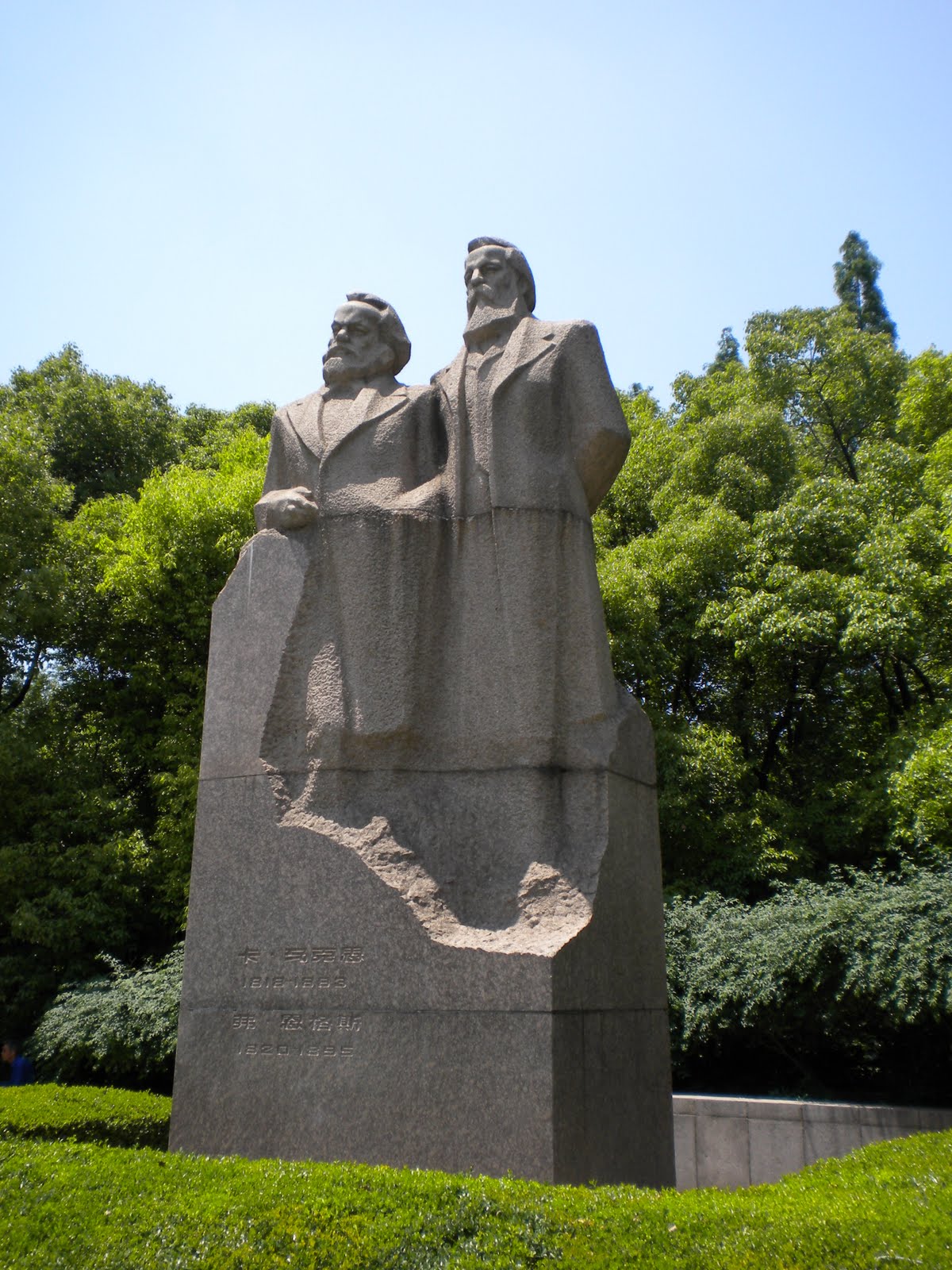
A tribute to Westerners?   Marx and Engels of course


St Nicholas Russian Orthodox Church--  Built in 1936 to service the large number of Russian emigrants coming to Shanghai in the 1930s.  The church escaped demolition during the cultural revolution, and has been used as a restaurant and a washing machine factory.  It currently is closed, and a guard (looking very bored) sits in front to prevent vandalism.

Sun Yat-Sen's residence--  now a museum.

Sun Yat-Sen residence-- front entry

Sun Yat-Sen Residence-- backyard

No trumpet Playing!--  The driveway to an old estate house along the walking tour


Lion (and Lioness) at the hotel/restaurant where we had lunch

Old and the New Shanghai--  Among the 21st century Shanghai, there are still vestiges of older times.  This vendor has his store on the back of his bicycle.  The cart is overloaded with brooms, dusters, mops, etc.  The Fuller Brush Man?  The woman is apparently a local customer who came out of the nearby building to make a purchase. There are also scrap collectors that use similar manual transport, moving about the shops collecting cardboard and plastic for recycling.

Moller House-- Swedish shipping magnate Eric Moller built this house, finally completed in 1949.  It housed the Communist Youth League for a while, and is now a hotel.  Moller delayed finishing its construction, having been told by a fortune teller he would meet his demise upon its completion .  He died in a plane crash in 1954.

Jingjiang Hotel--  (ca 1931)  The Shanghai diplomatic community were held under house arrest during the Japanese occupation of Shanghai in 1941.

Lobby of the Okura Garden Hotel (ca 1921)  Art Deco hotel in the French Concession

Russian Orthodox Mission Church-- (ca 1931)

Sensible Shoes-- High fashion in Shanghai.  Hot pink and overalls.

Donghu Hotel--  Not quite the Great Wall of China, but fairly imposing.  This estate, with imposing iron walls was once the home of a reputed gangster of Shanghai.  Now a hotel.

Birds are a traditional pet for the Chinese--  they often accompany their owner to tea houses when out on the town, and displayed in ornate cages (these are not the ornate cages).  These birds were just hanging around outside a shop.